


Two years of full‑service marketing for La Marzocco.

Globalist has managed SEO, Google Ads and Meta for La Marzocco Germany for more than two years.

Customer
La Marzocco
Sector
Specialty coffee · D2C + B2B
Market
Germany
Channels
SEO · Google Ads · Meta
  • 20 ×

    B2B Lead Volume · Meta

  • +129 %

    Visibility Index · SEO

  • +204 %

    B2C ROAS · Meta

A technical conviction that runs through almost a hundred years of company history.

What distinguishes La Marzocco from other manufacturers is not a marketing decision, but a technical conviction. 1939 Giuseppe Bambi patented the horizontal boiler: a design that enables constant pressure and temperature conditions throughout the brewing process, thereby laying the foundation for modern espresso extraction. 1970 This was followed by the GS model with double boilers and saturated brewing groups, which still defines the technical basis for commercial high-end espresso machines. When the Arno flood devastated Florence in 1966, the company helped affected customers repair their machines for free: a gesture that shows that behind the patents there is also a certain attitude.

In the following decades, La Marzocco became a reference in the professional barista field. Starbucks used the machines until 2005, La Marzocco was official sponsor of the World Barista Championships.

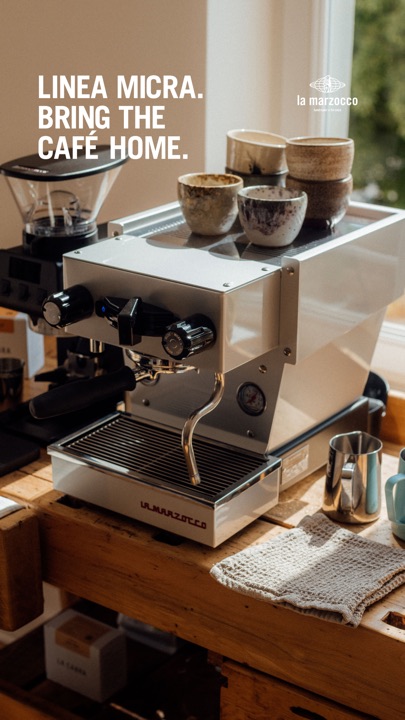
With the introduction of Linea Mini (2015) and the Linea Micra (2022) La Marzocco has brought commercial precision to the private kitchen: building a community that treats espresso not as a drink, but as a daily craft. This home line serves a target group that deals with the same brewing parameters and machine details as professional baristi.

The result is a company with two simultaneous sales logics: D2C in the home segment with high AOVs in the four- to five-digit range, and B2B in the commercial segment with cafés, roasting shops and specialty gastronomy as customers. Both worlds, completely different funnels, sales cycles and decision logics: within the same brand presence.

The common starting point

High-quality brands such as La Marzocco are facing a structural challenge: those who spend several thousand euros on an espresso machine have usually been informed for months: about boiler concepts, brewing group saturation, grinding tolerances. This research process is the gateway into the purchase decision, and it takes place today predominantly digitally.

At the same time, the same brand in the B2B segment must appeal to catering decision-makers who are looking for different signals and can be reached via other channels. Both distribution lines had to be set up in parallel: neatly separated from each other without cannibalizing each other.

This was the starting point for our work across all three channels.

A technique can be learned. Passion arises only through dedication, love, pride and respect for one’s own work.

Piero Bambi · La Marzocco

From flat visibility to top position for “screen carrier machine”.

Channel: SEO: Content, Category Optimization, Topical Authority.

Visibility index for
+129 % (from 0.1778 to 0.4075)
Impressions
+87,1 % (April 2026 vs.) April 2025
Clicks
+21,2 % (April 2026 vs.) April 2025

The starting position

The market for high-quality screen carrier machines in the DACH region is narrow. Generic search terms such as “screen carrier machine” are dominated by senders, test portals and price comparison sites: competitors with distribution advantage, more aggressive price positioning and a long-standing SEO presence.

Before our engagement, La Marzocco’s organic visibility trajectory hardly moved. The brand authority was strong offline, but hardly noticeable online for customers willing to buy at the decisive moment. Strong at the product level, weak at the searches that actually prepare purchase decisions. A classical constellation: strong brand, weak visibility.

The objective

La Marzocco should not only appear as a manufacturer in the German-speaking search market, but also as the natural first port of call for everything related to espresso, screen carriers and coffee culture. Specifically, this meant: top rankings on the important category keywords, a content architecture that covers the entire customer journey, and visibility that does not depend on individual rankings, but arises from structurally constructed authority.

The procedure

We have positioned La Marzocco in SEO as what the brand has long been in the coffee community: a knowledge reference. This required two parallel construction sites.

Topical authority by content depth. The blog was systematically expanded from an accompanying asset to a content platform. Contributions to brewing parameters, degree of grinding, water hardness, cleaning routines, latte type and machine care: exactly the topics that espresso enthusiasts Google before they even think about buying. These contents not only rank individually, but also interlink via internal linking and a thematic cluster system. The effect: Google no longer reads La Marzocco only as a manufacturer, but as an authority for the entire field of espresso.

Targeted category optimization. At the same time, the commercial category pages were consistently targeted at the competitive transaction keywords: structurally, technically and in terms of content. The most important result of this work: a permanent top 10 ranking for “Siebträgermaschine”, one of the toughest money keywords in the premium coffee segment.

Both strands are not an end in themselves. The informative content transports thematic relevance to the category pages, the category pages convert the traffic qualified by the content. No SEO dualism: a system.

The results

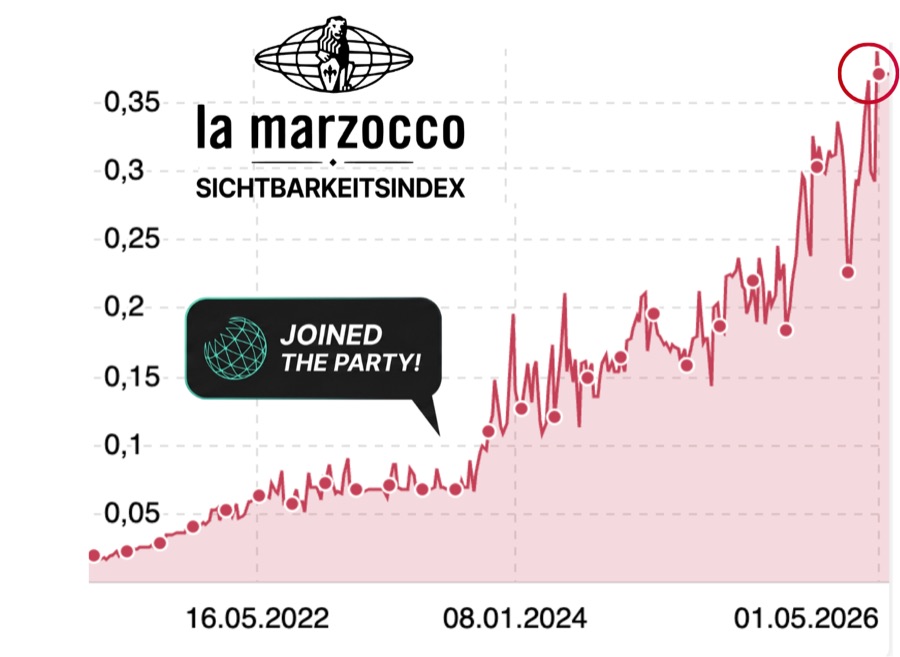
Visibility index +129 %. From 0.1778 to 0.4075 within 12 months. Not a short-term runaway movement, but a continuous increase that reflects the consequence of structural construction.

Visibility index profile · La Marzocco DE: +129 % in 12 months

Top 10 for “Siebträgermaschine”. Persistent ranking on the front for one of the most competitive keywords in the segment, flanked by a broad foundation of long-tail and mid-funnel rankings.

+87.1% impressions, +21.2% clicks (April 2026 vs.) April 2025. Figures directly from the Google Search Console: measured range and qualified traffic, not a tool artifact.

Content authority as a strategic asset. Today, La Marzocco covers the entire research cycle in the German search space: from the first question to the purchase decision.

Services provided

  • SEO Strategy & Topical Authority Building
  • Content concept & editorial support
  • Category optimization and technical SEO
  • Internal Linking & Cluster Architecture
  • Performance reporting and monitoring

View

Two years of SEO work have given La Marzocco a depth in the German search market that hardly any other premium coffee brand has. But a high visibility index is 2026 the entry ticket, not the destination.

The next stage of development is GEO stands for Generative Engine Optimization. LLMs and AI search systems do not cite by chance: they cite what is already established as an authority on the classical web. La Marzocco has this substance. What follows is the targeted optimization: systematic tracking of the citation rate in ChatGPT, Perplexity and Google AI Overviews, content structures that recognize LLMs as a source reference, and a bridge into the emerging LLM ad models.

This is the next step: classical search authority becomes a presence in the information systems that will soon shape decision-making processes.

B2B and B2C scaled in parallel: without mutual signal contamination.

Channel: Google Ads (Search, B2B Lead-Gen, B2C E-Commerce). Comparison period: 01.01. to 29.04.2025 vs. 01.01. to 29.04.2026.

B2B-CPL
Less than half of initial level reduced
CTR
+49 % year-on-year comparison
B2B pipeline
Continuously new leads from German cafés, roasting companies, catering companies

The starting position

La Marzocco brings with it a requirement that is rare in performance marketing: two completely separate sales logics in the same account. On the one hand, D2C e-commerce with the home line: transactional, measurable conversion value, relatively clear decision cycle. On the other hand, B2B lead generation for the commercial sector: gastro decision-makers, longer sales cycles, lead quality as a decisive variable.

Before our engagement, these strands were not clearly separated: B2C signals contaminated the B2B smart bidding, the campaign structure did not reflect the different funnels, and the tracking base after a website relaunch was not yet fully stabilized.

The procedure

The first step was not campaign optimization, but architecture. B2B and B2C were transferred into clearly separate strands: own campaign structure, own bidding logic, separate reporting in Looker Studio. The 50/50 budget split between the two areas was defined and consistently maintained as a strategic corridor.

B2B lead engine. The B2B campaigns were converted to HQ lead forms. Incoming requests are automatically handed over to the sales team: with name, company, city, email, telephone and campaign source. This closes the loop between campaign and sales, which is necessary for sustainable lead quality.

At the same time, the negative keyword strategy was consistently expanded: competitors, B2C leaks, foreign languages, generic office terms out. The goal was to provide a clean signal input for smart bidding that only allows for really relevant B2B requests. Conditional call ads: mobile at business time, landline outside: complement the setup on a tactical level. In addition, an RSA-A/B test was established in the Gastro ad group and the winner variant was deployed as a new standard.

Tracking and Database. The conversion tracking was stabilized after the website relaunch via PixelYourSite plus GA4, the GA4-to-Google Ads link was set up cleanly (generate_lead, guest_form_submit). Only on this basis can both funnels be reliably optimized.

Synchronization with SEO. The content work from the SEO channel: for example, the water hub article with water hardness calculator: was specifically integrated into the SEA structures. Paid search and organic content play in the same direction: The SEO channel builds thematic depth, SEA harvests the resulting intent.

The results

B2B lead funnel more profitable. The CPL was reduced to below half of the initial level: clear for several weeks in a row under the internal target corridor. The lead pipeline continuously delivers qualified inquiries from German cafés, roasting companies and catering companies.

Range and efficiency. CTR improved by around 49% year-on-year: more qualified traffic with stable spending. In a mature keyword market, this is not self-going.

Brand presence. La Marzocco appears in the paid search room consistent with the premium appearance that corresponds to the brand: not a generic ad structure, but an appearance that brings together brand identity and sales intention.

Services provided

  • Dual setup B2B/B2C: campaign structure & looker studio reporting
  • B2B Lead Strategy with HQ Lead Forms & Automated Lead Transfer
  • Negative Keyword Management & Audience Cleanup
  • RSA-Testing & Ad Optimization
  • Conversion tracking stabilization (GA4, PixelYourSite)
  • Synchronization of content with SEO content strategy
  • Weekly Performance Reporting & bi-weekly JourFixe

B2C ROAS tripled, B2B pipeline almost twenty‑fold.

Channel: Meta Ads (Facebook & Instagram).

B2C ROAS
+about 204%Premium profitability tripled
B2C CPAS
−about 58 %
B2C purchases
+approximately 23 %: more output with significantly less investment
AOV
+approximately 26 %: Premium positioning strengthened
B2B lead volume
Approximately factor 20x: Pipeline from DACH cafés, roasting companies, gastro
B2B CPL
-approximately 91%: consistently under internal target corridor

The challenge

At the start of the comparison cycle, the account showed an image typical of premium brands with dual distribution logic.

On the B2C side : Machines in the high four- to five-digit range, for which volume mechanics simply do not work. Discount levers are eliminated. Efficiency does not come about through price pressure, but through identifiability: via assets that are immediately recognizable as La Marzocco and appeal to the right people.

On the B2B side : Requests were slow, not a standardized process for push and pull. Espresso enthusiasts and gastro decision makers don’t fit into standard lookalike setups, and the range ceiling at this special audience was quickly reached.

As a common denominator of both sides: Incomplete conversion signals. The tracking was not clean: every optimization ran on unstable foundations.

The order was therefore not a classic “more spend”. It was: first stabilize database, then consistently build two separate funnels.

The strategy

We do not think of meta as an independent channel, but as a lever within an overarching system: coordinated with SEA and SEO, measured against real business leverage. The strategy was based on four pillars.

Dual account logic. B2C and B2B were transferred into two clearly separate campaign lines. The B2C conversion campaign with Home/D2C logic runs completely separately from the B2B lead campaign with Gastro/Commercial logic. No crosstalk between the strands, no signal contamination in bidding.

Creative as a brand carrier. Asset families were structured consistently along manufacture, machine and barista hand: with clear funnel roles instead of platform arbitrariness. The question was not what looks good on Meta, but what makes La Marzocco immediately recognizable. Identifiability of the brand was the actual KPI.

B2B lead engine as an operational system. Geo-control on relevant B2B locations, lead forms with qualifying fields, automated real-time transfer to the sales team. The feedback from the contacts flows back into the campaign control and iteratively qualifies the audience. This loop is the lever that sustainably pushes CPL: without compromising on lead quality.

Data base as a prerequisite, not as an afterthought. Conversion tracking has been consistently stabilized, B2B lead events have been cleanly defined and set up as a reliable signal source. The order: first data truth, then scaling: is often the invisible reason why numbers end up holding or not.

Implementation

Account architecture first. Before a euro budget was postponed, the two strands were neatly separated from each other and set up structurally.

Lead operations. Incoming B2B requests are handed over directly to the sales team with all relevant fields. The feedback from these contacts further qualifies targeting and creative iteratively.

Cross-channel voting with Google Ads. The B2C/B2B separation was transferred on the same train to the Google Ads setup: separate account logic, common database. Meta opens the market and pushes qualified demand into awareness and consideration, Paid Search intercepts the emerging intention transactionally.

The results

B2C strand. The Home/D2C funnel delivers more purchases, almost triple profitability per euro invested and a noticeably higher shopping cart value. The fact that the AOV has risen shows that brand positioning carries over the creative: the right people buy the right products.

B2B strand. Lead volumes barely twenty-fold, CPL reduced by more than ninety percent: with an expanded quality loop that ensures that leads really become customers.

Total account. Significantly higher advertising sales, almost half more profitability, and a B2B pipeline on a scale that did not exist in this form before.

Holistic conclusion

This case is not a pure media buying case. Media-buying was the executor: the decisions before, about architecture, data truth and the consistent separation of the two sales logics, were the real lever.

Driving sales with TikTok Video Shopping Ads.Next Success Story

Write your next success story.

Book a free 30-minute strategy call. We'll look at where you stand and identify your first opportunities for growth.